Category: Uncategorized

  • How to Design Custom Doormat Artwork That Prints Clean

    How to Design Custom Doormat Artwork That Prints Clean

    Most doormat reprints do not happen because the mat was made wrong. They happen because the artwork was never suited to the material or the print method in the first place. A logo that looks crisp on a screen at 100 percent zoom can turn muddy on a coir weave, and a photo that prints beautifully on a poly-topped mat can look like a smear on natural fiber. If you sort out a handful of specifications before you send a file, you skip that whole loop. Here is how to think through each decision in the order that actually matters.

    Start with the print method, not the picture

    The single most useful thing you can do is decide how the mat will be decorated before you finalize the art, because the method sets hard limits on what the art can be. Natural coir and other coarse fibers are usually decorated by spray-dye or screen printing: dye is pushed onto the surface through a stencil. That process is excellent for bold shapes, chunky lettering, and a small number of flat colors, but it cannot reproduce photographic gradients or hairline detail, because the fiber is uneven and the dye spreads into it. As a rough guide, treat strokes and gaps thinner than about half an inch as unreliable on coir; they tend to fill in or break up.

    Poly-surface and needle-punch mats are a different animal. They take dye sublimation, where a full-color image is heat-transferred into a polyester print layer. That method handles photographs, gradients, and fine detail, so if your design depends on a soft color blend or a detailed illustration, you almost certainly want a poly-top mat rather than raw coir. Rubber and PVC mats sit at the other end: they are typically molded, debossed, or fitted with a printed inlay, which suits solid one- or two-color logos more than anything painterly. Matching the art to one of these three lanes at the start prevents the most common disappointment, which is expecting photo detail from a fiber that physically cannot hold it.

    Size the canvas and protect a safe area

    Custom mats cluster around a few standard footprints, and knowing them lets you build the file at the right proportions from the beginning rather than stretching art later. The four most-stocked sizes run from a compact 18 by 30 inches up to a large 36 by 60 inches, and the jump in print area between them is bigger than it looks.
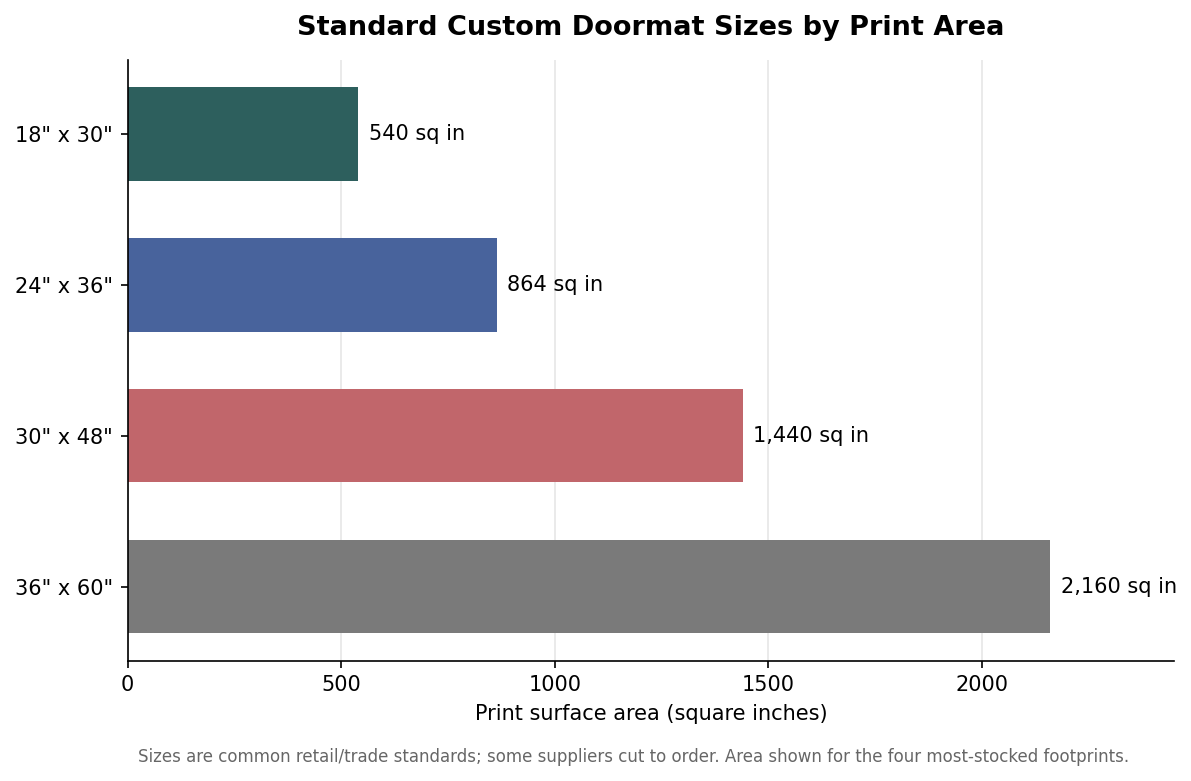
    Horizontal bar chart of four standard custom doormat sizes and their print surface area in square inches, from 18 by 30 inches at 540 square inches to 36 by 60 inches at 2,160 square inches
    The four most-stocked doormat footprints and how much print area each gives you.

    Whatever size you choose, keep the important elements inside a safe area inset roughly one to one and a half inches from every edge. Many mats have a molded or woven border, and cutting, binding, and the edge of the print zone all eat into the outer margin. If your text or logo runs too close to the edge, part of it can land on the border or get trimmed. At the same time, if the design is meant to reach the edge, extend the background past the trim line into the bleed so you do not end up with a thin unprinted stripe when the mat is cut slightly off-center. Design for the safe area, bleed the background, and you cover both failure modes.

    Resolution, color, and file format

    For anything with clean edges, a logo, lettering, a monogram, or a line illustration, vector files win every time. An AI, EPS, PDF, or SVG scales to any mat size without losing sharpness, so a single vector logo works as well on the 18-inch mat as on the 60-inch one. When you only have a raster image, the question becomes whether it has enough pixels for the final size. A practical target for a floor graphic, which people view from standing height rather than up close, is about 150 dots per inch at print size. Translate that into the file dimensions and the requirement grows quickly with the mat.
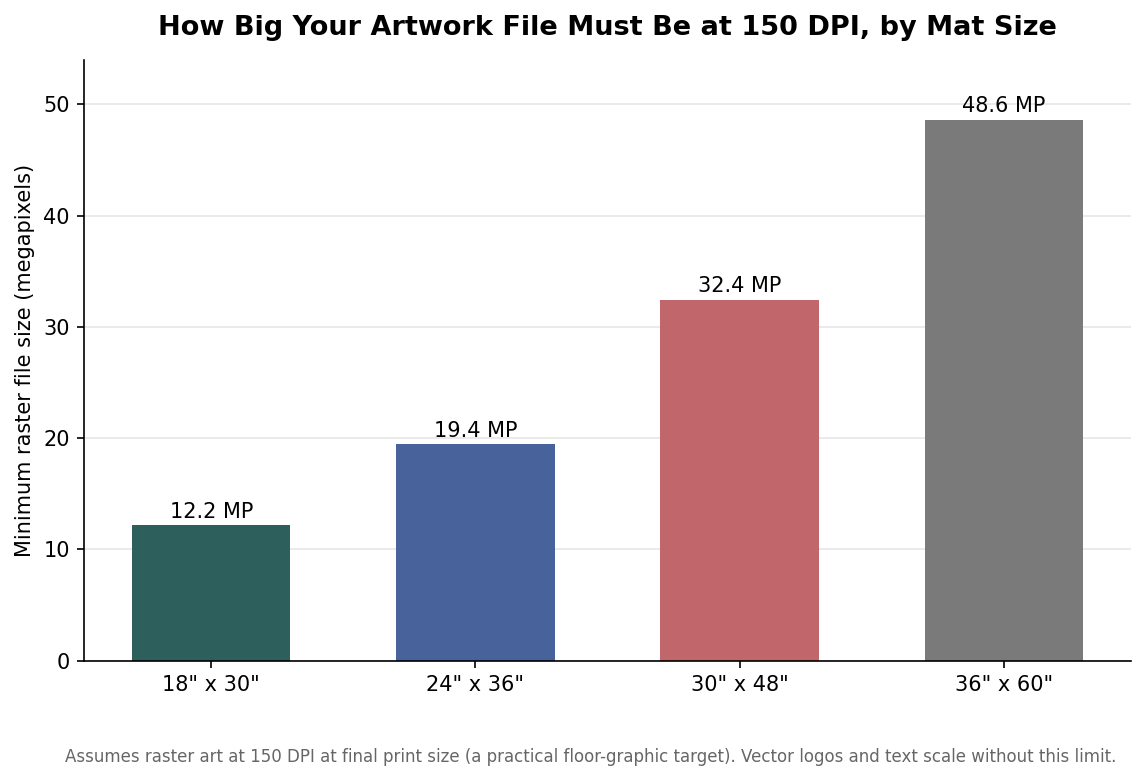
    Bar chart showing the minimum raster artwork file size in megapixels needed at 150 DPI for each standard doormat size, rising from 12.15 megapixels to 48.6 megapixels
    Minimum raster file size by mat size at a 150 DPI target; vector art avoids this limit entirely.

    Color is the other place files go wrong. Screens show color in RGB, and some of the brightest RGB values, the electric neons and backlit blues, simply cannot be reproduced with dye and will shift toward a duller neighbor in print. Check how your colors behave in the print color space before you commit, and remember that on natural coir the tan fiber shows through and warms every color placed on it, so a cool gray can read as beige. Because a mat is seen from several feet away and collects dirt as it works, lean on high contrast and heavy letterforms. Text you want to read from a standing position should be generously sized, on the order of one and a half to two inches tall as a floor, not a ceiling; thin script at a small size is the first thing to disappear.

    The mistakes that trigger a reprint

    A short list of errors accounts for most do-overs. Thin outlines and small text on coir top it, because the weave swallows fine strokes. Low-resolution source images come next, usually a logo pulled from a website or a screenshot that looked fine on a phone but falls apart enlarged to two feet. Low contrast is a quiet killer: a mid-tone design on natural fiber can look washed out the moment it is dirty. Full-bleed art sent for a mat that actually has a border gets clipped. And the broadest mistake is a mismatch of ambition and material, expecting a photograph to survive on a surface built for bold shapes.

    Before you send a file, it is worth running a quick mental pass. Confirm the decoration method and that your art fits what it can hold. Confirm the mat size and that your file is either vector or has enough pixels for that size at roughly 150 DPI. Confirm your elements sit inside the safe area with the background bled past the edge, that your colors are ones dye can actually hit, and that your smallest text is large and bold enough to read from where a person stands. Numbers like the half-inch minimum stroke and the 150 DPI target are indicative rather than absolute, and a good printer will flag a borderline file, but clearing them yourself is what turns a single proof into a finished mat instead of a second attempt.
  • How to Choose the Right Doormat Size: A Measuring Walkthrough

    How to Choose the Right Doormat Size: A Measuring Walkthrough

    A doormat that is the wrong size is the most common and most avoidable mistake in an entryway. Too small and it looks like a postage stamp under a full-height door while letting grit track straight past it; too large and it fouls the door swing or overhangs the step. The fix is not taste, it is measurement. Spend five minutes with a tape measure before you order and the size question answers itself.

    This walkthrough goes in the order you should actually work: measure the opening, apply the width rule, set the depth for how people wipe their feet, and only then check the two clearances that quietly ruin otherwise perfect orders. Custom mats are made to the size you specify, so the responsibility for getting it right sits with the measurement, not the maker.

    Start with the door, not the mat

    Measure the opening first. Stand at the threshold and measure the clear width of the doorway, then the width of the door slab itself, and note whether the door swings in or out. A standard single exterior door is about 36 inches wide. A double or French door pair is usually somewhere between 60 and 72 inches across the two slabs, and a sliding patio unit commonly runs 72 inches and up. Those opening numbers are the anchor for everything that follows; the mat is sized to them, not to the doorway you wish you had.

    Write down the swing direction while you are there. An out-swinging storm or screen door sweeps across the exact space the mat wants to occupy, and that single fact often decides whether you can use a thick coir mat or need a low-profile one. It is the detail people skip and then discover on delivery day.

    The width rule, and when to break it

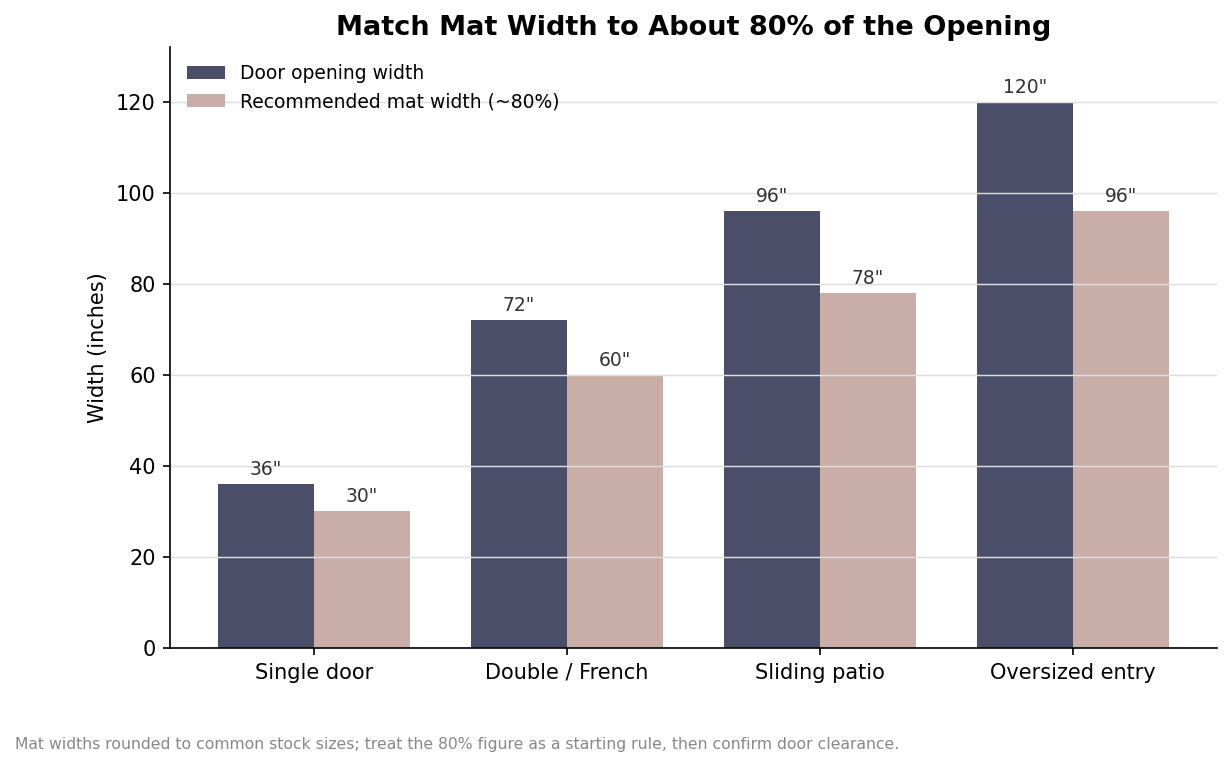
    The workhorse guideline is that a mat should span roughly 80 to 90 percent of the door’s width. It should read as clearly belonging to the door, stopping a little short of the frame on each side rather than either hiding under the slab or spilling past the trim. For a 36-inch single door that lands you at a mat around 30 inches wide, which is why the 24-by-36-inch size is the perennial default for single entrances and the 18-by-30-inch mat is the compact standard for tighter stoops.

    Scale the same rule up and the sizes fall out cleanly. A double or French entrance wants a mat in the neighborhood of 60 inches wide, which is why makers list an extra-large mat of at least 24 by 60 inches specifically for double doors. A wide slider or an oversized custom entry pushes wider still. The 80 percent figure is a starting point rather than a law, though: a covered porch with room to spare can carry a mat that runs the full width of the doorway for a more grounded look, while a narrow landing may force you a little under the rule to keep the door clear.

    Grouped bar chart comparing door opening width to recommended doormat width for single, double, sliding and oversized entries
    Sizing mat width to about 80 percent of the opening across four common entrance types.

    Set the depth for how feet actually move

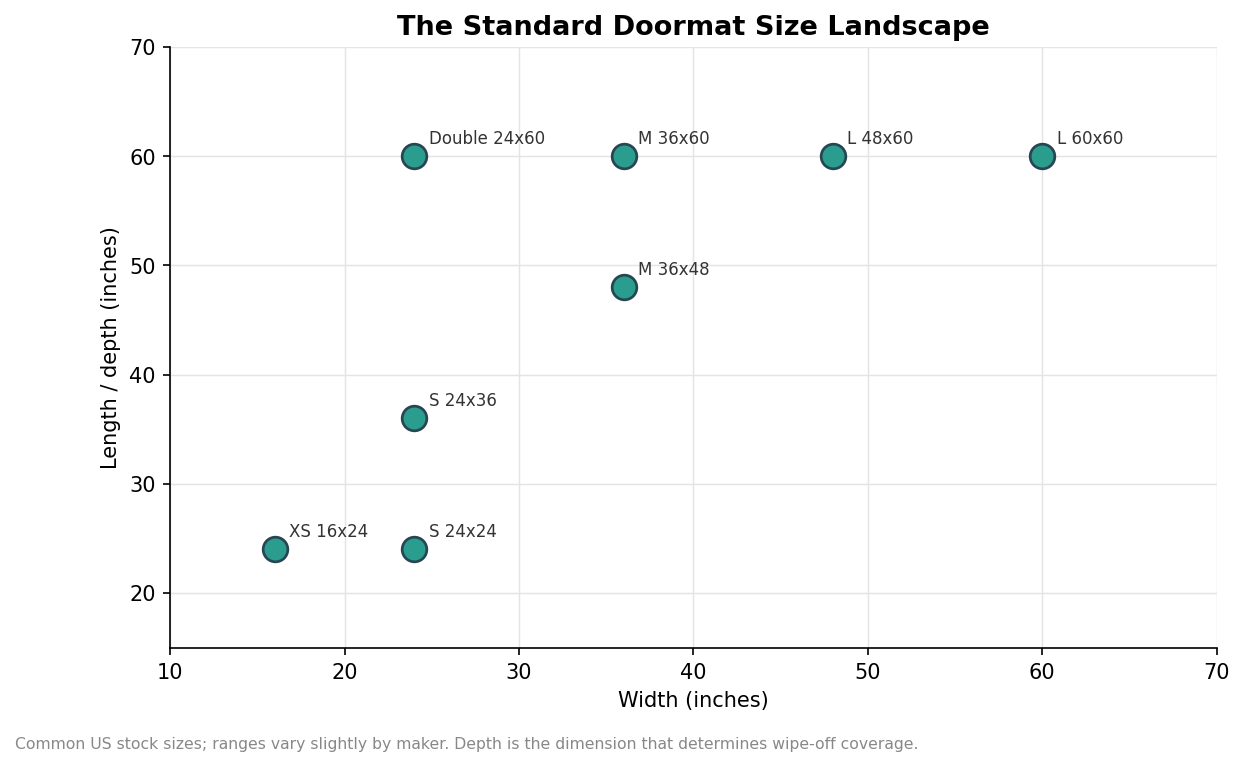
    Width gets the attention, but depth, the front-to-back dimension, is what determines whether the mat does its job. A doormat only works if a person takes at least one full step on it, and ideally two, so both feet contact the surface before they reach the threshold. A shallow 18-inch mat gets one glancing step; a 30-to-36-inch depth gets the two strides that actually pull grit and moisture off a shoe. This is why the standard sizes deepen as they widen, and why a wide, shallow runner can look right and still underperform a smaller mat with more depth.

    For a high-traffic or wet-climate entrance, favor more depth even at the cost of a slightly less tidy proportion. The mat is a filter, and a filter needs surface area in the direction of travel. If you are choosing between a 24-by-36 and a 36-by-48 for a busy family door, the deeper mat will keep more dirt out of the house, full stop.

    Scatter plot of standard US doormat sizes by width and depth in inches
    The common stock-size landscape; depth is what determines how much a mat actually wipes off.

    Check the two clearances people forget

    Two vertical measurements decide whether your correctly-sized mat will actually sit flat and let the door open. The first is the gap under the door. Measure from the finished floor to the bottom of the door slab; a thick coir or rubber-backed mat can easily stand a half-inch to three-quarters of an inch tall, and if that height exceeds your under-door gap, an in-swinging door will jam against it or drag. Where the gap is tight, specify a low-profile mat, often a quarter-inch or less, rather than a plush one.

    The second is threshold and step geometry. If the mat sits on a landing at the top of a step, keep its front edge back from the nosing so no one catches a toe on an overhanging edge, and make sure a raised threshold strip does not hold one end of the mat up in a curl. These are indicative cautions rather than fixed numbers because every entry differs, but they are the failures that turn a well-measured mat into a trip hazard or a door that no longer closes.

    Turning the measurements into an order

    By this point the specification writes itself. You have an opening width, a mat width at about 80 to 90 percent of it, a depth chosen for one or two full strides, and an under-door clearance that caps how thick the mat can be. Translate those into the nearest standard size for the best value, or give the exact width and depth if you are ordering a custom mat and the standard grid does not fit your entry. Note the swing direction and the thickness limit on the order itself so nothing gets lost.

    Do that and the mat arrives sized to the door rather than to a guess: wide enough to look deliberate, deep enough to catch what shoes carry in, and thin enough that the door still swings clean over it. Every other decision about a doormat, from material to lettering, is easier once the dimensions are right, and none of them can rescue a mat that is the wrong size for the door it guards.

  • Coir vs Rubber: Which Doormat Suits Your Door?

    Call or Text us: (929) 605-4397
    Specs

    Coir vs Rubber: Which Doormat Suits Your Door?

    The deciding factor is cover, not cost

    These are the two materials most buyers choose between, and the deciding factor is not appearance or price. It is whether your entrance has a roof over it.

    Where coir wins

    Coir is coconut husk fibre. The bristles are stiff enough to scrape a boot properly, the look is warm and natural, and dyed designs sit inside the fibre rather than on top. Under a porch or canopy it is hard to beat.

    Where coir fails

    Standing water. Coir is organic and a mat left saturated through a wet winter will break down far sooner than the same mat under cover. If your doorway is fully exposed, coir is the wrong specification no matter how good it looks on day one.

    Where rubber wins

    Rubber handles exposure without complaint, grips hard floors so the mat does not creep, and seals the underside so water pushed through does not sit on the floor beneath. On tile or polished concrete that last point is a genuine safety matter.

    You can have both

    A rubber scraper outside and a coir or absorbent mat inside is the standard arrangement for a reason. Minimum order is 12 mats, production runs 2 weeks, and the mockup is free within 24 hours.

    Create your custom doormats now.

    Send your logo, quantity and date — you’ll get a free mockup and quote within one business day.

    Get a Quote
    GET A QUOTE
  • Why a Branded Entrance Mat Outperforms Most Signage

    Call or Text us: (929) 605-4397
    Business

    Why a Branded Entrance Mat Outperforms Most Signage

    The one surface everybody looks at

    Businesses spend heavily on signage that customers glance at once. The mat at the door is looked at by everyone who enters, costs a fraction as much, and does a second job at the same time.

    People genuinely look down at a threshold

    Crossing a threshold is one of the few moments people reliably look at the floor. That is why a branded mat registers far better than its cost suggests, and why hotels have used inlay logo mats in lobbies for decades.

    It protects the floor it advertises on

    No other piece of signage also reduces your cleaning bill and your slip risk. The mat is doing a real job regardless; branding it is close to free marketing on top of a cost you were already carrying.

    Specify it to last

    A faded, curling mat says more about a business than a blank one would. If it is going to carry your name, use an inlay so the colour runs the full depth, and put a heavy rubber base under it so it stays straight.

    Size it to the doorway

    Standard sizes are a compromise. Send us the dimensions of your actual entrance and we will quote the exact size. Minimum order is 12 mats, production runs 2 weeks, and your free mockup arrives within 24 hours.

    Create your custom doormats now.

    Send your logo, quantity and date — you’ll get a free mockup and quote within one business day.

    Get a Quote
    GET A QUOTE
  • Custom Doormats: A Buyer’s Guide

    Call or Text us: (929) 605-4397
    Buyer’s guide

    Custom Doormats: A Buyer’s Guide

    Match the mat to the entrance, not the budget

    A doormat is the only thing in your building every single visitor touches. Most are bought on size and colour alone, which is why so many are wrong within a season.

    Start with one question: is the entrance covered? Natural coir is excellent under a porch or canopy and poor in standing water. A fully exposed doorway needs a scraper or rubber-backed mat instead, and no amount of design fixes that mismatch.

    Scraping and absorbing are two different jobs

    A scraper mat strips mud and grit and drains water away. An absorbent mat pulls water off a sole and holds it. They are not interchangeable, and the best entrances use both: scraper outside the door, absorbent inside it. That two-stage arrangement removes far more dirt than any single mat.

    Decide how long the branding has to last

    A printed or dyed design wears gradually with the pile. An inlay is cut from contrasting rubber and set into the mat body, so the colour runs the full depth and cannot wear away. Inlay costs more per mat and much less per year.

    Do not forget the base

    The most common complaint about entrance matting is creep, not wear. On tile or polished concrete a heavy rubber base is what stops the mat migrating across the lobby all day.

    What to expect when you order

    Send your doorway dimensions and whatever artwork you have. You will get a free mockup within 24 hours, unlimited free revisions, and you pay nothing until you approve it. Minimum order is 12 mats and production runs 2 weeks, with faster turnaround available on express shipping.

    Create your custom doormats now.

    Send your logo, quantity and date — you’ll get a free mockup and quote within one business day.

    Get a Quote
    GET A QUOTE
  • Hello world!

    Welcome to WordPress. This is your first post. Edit or delete it, then start writing!